Monday, July 2, 2012

IN PARADISE OF KUMANA


Boarding the yala National park to the east is the well- known bird sanctuary, Kumana. As you approach Kumana you hear a rather noisy invitation – the sound of thousands of birds calling one another. Here a large variety of indigenous acquatic birds gather from April to July marking Kumana a birdwatcher’s paradise. There are herons, Storks, egrets and spoonbills nesting in the trees above, Water hens, Purple coot and jacana build their nests in the swamp below.

Saturday, June 30, 2012

Human Blood Circulation


Imagine being smaller than the period at the end of the sentence. Imagine being microscopic! Suppose you are almost as tiny as a red blood cell. Picture your self inside a human heart. You are about to take a guided tour of a human circulatory system.
                Your tour being in the right at rium of the heart. It is a dark chamber with thin walls. Wow……..Is it crowded! Millions of blood cells are in the right atrium with you. Most of the cells are about your size. The guide says that, they are red blood cells “Each one is shaped like a doughnut with no hole. Most have no nucleus. Every red blood cell carries a load of carbon dioxide”
                The large cell with nuclei are white blood cell “the guide continues” what are the disk shapes?” you ask “They are platelets,” the guide answers, “and the yellowish, watery substance around you is plasma.”

Saturday, May 19, 2012

Renal diseases are on the rise


What is kidney failure?
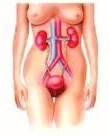
               Kidney is the organ that purifies the blood and is responsible for filtering blood, removing waste and making urine to keep the body’s water and salt balance in check. When the kidney stops functioning this process can not go on.
 
What is the role of the dialysis machine?   
                              When the patient’s kidney ceases to function, the machine will play the role of kidneys. The machine will take the blood in and send it through an artificial kidney which the blood, and send it to the patient.

Tuesday, May 15, 2012

Natural Photos


Date      :-2010-07-26
Photo     :-Kandiyan dance flower
Camera :-Canon, Digital,IXUS 975IS
Photographer:-Shamitha Shane


Wednesday, April 25, 2012

Cell (The fundamental unit of life)

Latin world for cell is "cellula" which means 'a little room'.The word 'cell' has derived from the above Latin word 'cellula'.The British botanist Robert hooke while examining a bottle cork under the microscope made by himself, observed room like structutes as in a honey comb. He named the little rooms of the honey comb as cells. Actually he has  seen only the cell wall.
                              All the living organisms are made up of cells. There are some organisms of which the body is made up of only one cell. They are called unicellular organisms. Organisms with more than one cell are multi cellular organisms.
                            It was MATTAIAS SCHLEIDEN in 1838 who first proposed the idea that all plants consist of calls.

Saturday, April 7, 2012

The Beauty of Sri Lanka

 
Once they called her the “Glittering petal of the Indian ocean". And again as  "The Living paradise on earth".  Further  they went on to say "The Isle of virtue";"The barn of far east". Now it is the Sri Lanka; 
our motherland. Endowed with natural & cultural beauty, she marches through 21st century.
                 With wide diversity of nature, she host most of living beings of animals & plants, prevail on earth. Travelling through the country, experiencing the typical tropical conditions of sandy breathtaking beaches, wetty & watery  feeling of rainy forests and cool, breezy, misty secludes of mountains  , are a matter of few hours. Populated by a nation; nourished by the teachings of Great Buddha, she inherits a rich culture, which runs over 2500 years of written history and her  warm, welcoming holspitality has largely spread all over the globe too.
 

Wednesday, March 14, 2012

Virus


Viruses are not actually cells. They do not need food as a source of energy. The only living process occurs in virus is reproduction; but they can not reproduce independently.
                                          Virus have a coat of protein enclosing a strand of nucleic acid. Only one nucleic acid is found in a virus. That can be either DNA or RAN. DNA is Deoxyribo Nucleic Acid. And RNA is Ribo nucleic Acid. Viruses infect and take over the biological machinery of cells to reproduce new viruses. Viruses are totally parasitic. Chicken pox, measles, aids, common cold, influenza are some diseases caused by viruses.                                                  

Protozoa


Amoeba
Protozoa are unicellular organisms. Protozoa can be subdivided in to Rhizopods, Ciliates, flagellates and sporozoans.
                  Rhizopods can move by means of pseudopodia. They also catch their prey by means of these catch their prey by means of these pseudopodia.
  
eg. Amoeba.
 
Microscopic hairs called cilia are present around the cell in ciliates. They use these cilia for feeding and movement. Paramecium is an example for ciliates.

Saturday, March 10, 2012

FUNGI


Most fungi are multi cellular. Yeast is an exception and it is a unicellular fungus. Multi cellular fungi are made up of hyphae. Hyphae are fine thread like structures.
                          No chlorophyll is present in fungi. Fungi are saprophytic, parasitic or symbiotic. Saprophytic means living on dead organic matter.                                 
                     Parasitic means grows feeds and shattered on or in a different organism while contributing nothing, to the survival of its host. Symbiotic means helping each other for nutrition.(mutually advantageous) eg. Lichens are a symbiotic partnership between algae and fungi.
                                     Yeast feed by changing sugars into alcohol, a process known as fermentation
     

ALGAE

Some algae are unicellular i.e. their bodies are composed of only one cell. They can only be seen under a microscope.
                  The largest algae are giant seaweeds some of which grow to over 50 meters long. They contain the green pigment chlorophyll and can produce, food by photosynthesis.
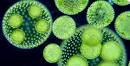
                              Green algae are formed in the sea, in fresh water, and in damp places on land. They occur as single cells, hollow bellow of cells, and fine threads.
Green Alga
                                              
Algae are of four types.
 
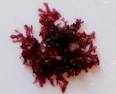
Rad Alga
01.   Green algae
02.   Brown algae 
03.   Red algae
04.   Diatoms
 
Diatoms are microscopic, single celled algae whose cell walls are made of silica.
 Some examples for green algae are,
 
                    01. Chlamydomonas  
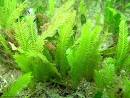
                02. Ulva    
                03. Spirogyra
Ulva